
Arrive by boat441 reviews
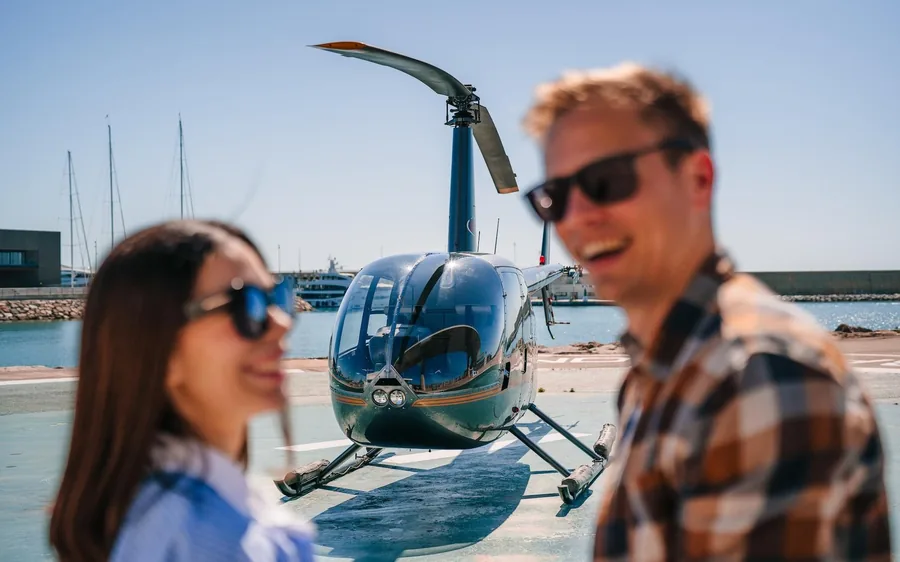
1 hBarcelona: Helicopter Flight & Boat Transfer
★ 4.7 · 441 reviews
- You reach the heliport by boat, not by taxi
- About an hour door to door
- 441 reviews at 4.7
- Small group
$185$26.43 / minute in the air
Check availability→ The heliport
Every helicopter over this city lifts from the same concrete square. Barcelona Heliport sits on the Moll Adossat, the long pier that runs out into the harbour past the cruise terminals, and it is the one part of a helicopter trip that catches people out — because there is no metro to it, no bus that stops at it, and no walk that is pleasant.

Quick answer
Barcelona Heliport is on the Moll Adossat in the Port of Barcelona, out beyond the cruise terminals, and the only sensible way to reach it is by taxi. Allow fifteen to twenty minutes from the city centre and arrive fifteen minutes before your slot for the briefing. One listing on this site — $185 — crosses the harbour by boat from Port Vell instead, which removes the problem entirely.
Getting there
Take a taxi and ask for the heliport on the Moll Adossat, or book the listing that brings you across by boat.
1. By taxi, from anywhere in the city. The honest default. Ask for the heliport on the Moll Adossat — not the airport, and not the port entrance, which is a long way short of it. Fifteen to twenty minutes from the centre in normal traffic, longer when a cruise ship is turning around. Tell the driver you are flying and he will take you to the gate rather than the terminal.
2. By boat, if you book the listing that includes it. The $185 flight begins at Port Vell and crosses the harbour by boat, about fifteen minutes on the water, and the transfer is genuinely one of the better parts of it. The four-hour land, sea and air morning at $231 does the same thing from the Moll de les Drassanes.
3. By car, if you have one. There is parking on the pier, and the drive in past the container cranes is stranger than you expect. Barcelona is not a city where a hire car is much use otherwise.
4. On foot, only if you want to walk a working quay. The Moll Adossat is roughly two kilometres of working port from the nearest point a bus will drop you, with no shade and no footpath worth the name. People do it. They arrive hot.
On arrival
The ground part is short and the same everywhere here.
Passport or ID card, and your booking. Bring the document even for a domestic hop — it is listed as required on every flight on this site.
Quietly, on a floor scale. The limit is 130 kg per passenger and anyone over 110 kg pays for a second seat, so this is not a formality.
How the harness works, how the door works, where not to walk. The cheapest listing builds this into its advertised schedule.
By weight, so the aircraft balances. Three passengers, and you do not choose your window.
Ducking, with the rotor already turning on most turnarounds. It is loud and it is the part everyone remembers.
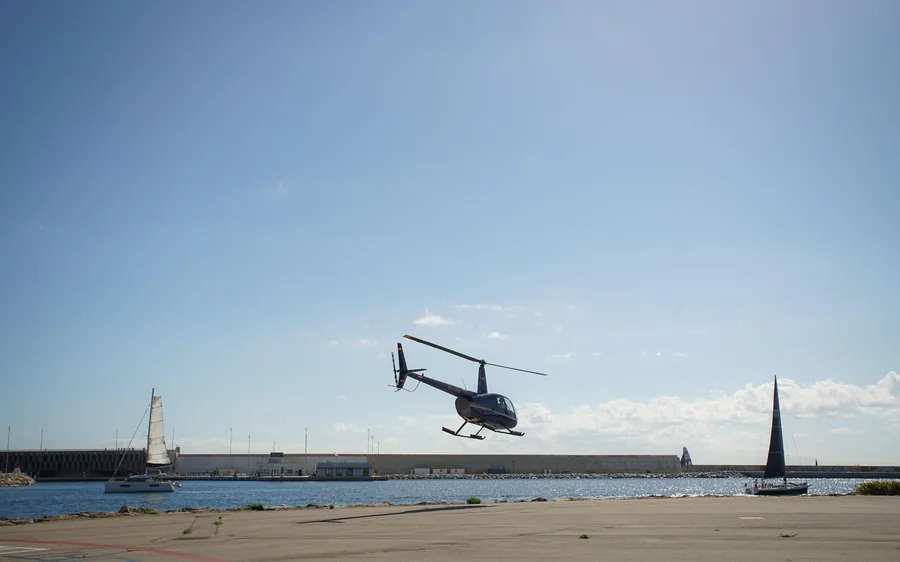
On the same square. Take-off and landing are the same point on every city flight here.
The heliport is the reason the $185 listing exists. If you are staying anywhere near the old town and do not want to argue with a taxi about a cargo pier, that is what you are paying the difference for.
Booking, lead times and cut-offs→The airspace
Controlled airspace, an airport eleven kilometres down the coast, and one cleared pier to work from.
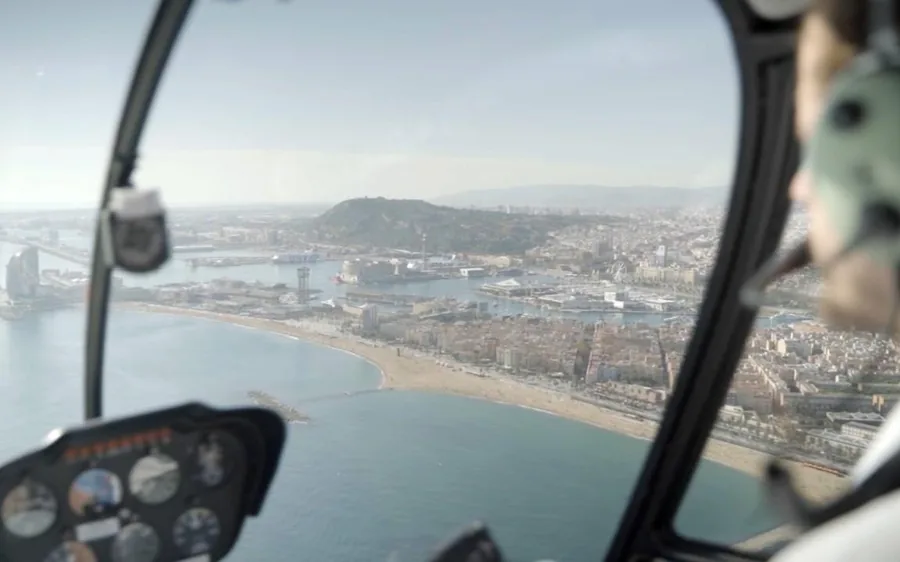
Barcelona sits under controlled airspace. El Prat airport is eleven kilometres down the coast and its approach paths run along the shoreline, so a sightseeing helicopter over the city is not free to wander: it works to a cleared route, talks to the tower on the way out and on the way back, and holds an altitude block.
That is why every flight starts and ends on the same pier, why the operator confirms your slot the day before rather than selling you a time at booking, and why the routes are so consistent from one listing to the next. The seven-minute circuit over the port and the twelve-minute circuit that turns inland are not marketing inventions. They are the two cleared shapes, sold by several companies from the same square of concrete.
It also explains the one thing people find odd about Barcelona Heliport: that it is a long way from the city it flies over. A helipad in the Eixample would be unworkable. A pier sticking out into the harbour, clear of the approach, is the only place it could be.
Book direct
Two listings bring you to Barcelona Heliport across the water. The other two are cheaper and leave the taxi to you.
★ 4.7 · 441 reviews
★ 4.7 · 1,364 reviews
★ 4.6 · 522 reviews
★ 4.6 · 378 reviews
The pier itself
A working cargo pier, chosen because it is clear of El Prat’s approach and has the sea for a departure path.
The Moll Adossat is not a tourist address. It is a two-kilometre finger of reclaimed land built out into the harbour, with the cruise terminals along one side, fuel and container quays along the other, and Barcelona Heliport near the root of it. Getting there means driving the port road past gates, weighbridges and lorries, and then arriving at a small building with a windsock.
The reason is airspace. El Prat is eleven kilometres down the coast and its approach runs along the shoreline; the city itself sits under controlled airspace with a dense, low skyline. A helipad in the Eixample would be unusable. A pad on a pier that already sticks out into open water, clear of the approach and with the sea for a departure path, is the only place it could sensibly be — which is exactly why Barcelona Heliport is where it is.
It also explains the shape of every flight sold here. Take-off and landing are the same point, the first and last minute of every circuit are over the harbour, and the operators work to two cleared routes rather than improvising. When several companies advertise almost the same seven- and twelve-minute flights, it is because they are flying the same two shapes out of the same square of concrete.
Practicalities
Small, and each one has caught somebody out.
Not “the port” and not “the airport”. The port entrance is a long way short of Barcelona Heliport.
Three ships changing passengers puts a lot of coaches on a single road. Twenty minutes can become forty.
Port access is controlled, and the desk checks it before the weigh-in.
Taxis do not queue at Barcelona Heliport the way they do at a hotel. Ask the desk to call one, or book the flight that brings you back across the harbour by boat.
You go out under a turning rotor, so hats, scarves and loose straps stay inside.
If you are early, and it is the best possible briefing for what is about to happen.
Common questions
On the Moll Adossat, the long pier in the Port of Barcelona that also serves the cruise terminals. It is about six kilometres from Plaça de Catalunya.
By taxi, in fifteen to twenty minutes from the centre — ask for the heliport on the Moll Adossat. Or book a flight that includes the boat transfer across the harbour.
No. The Moll Adossat is a working port pier with no public transport to the door. The nearest drop-off leaves you a long walk with no footpath.
Fifteen minutes before your slot. Check-in, the weigh-in and the safety briefing all happen in that window.
Every city flight does. The Costa Brava listing takes off and lands at its own point up the coast, and the Alella winery flight leaves Barcelona Heliport and lands in the vineyards.
Yes, there is parking on the pier. In a city with this much transport, a hire car is rarely worth it for anything else.
Go deeper
From $136 to $2,021, and what a minute in the air is worth.
The verdictOne recommendation for each kind of traveller, and why.
Sagrada FamíliaWhich flights reach it — and which never leave the port.
Camp NouThe stadium, the Olympic Ring and Montjuïc on one leg.
MinutesWhat each length actually covers over a compact city.
The coastPort Vell, Barceloneta, the beaches and the Fòrum.
Barcelona: Helicopter, Boat Ride & Old Town Small-Group Tour
★ 4.9 · 646 reviews · Free cancellation 24 h